
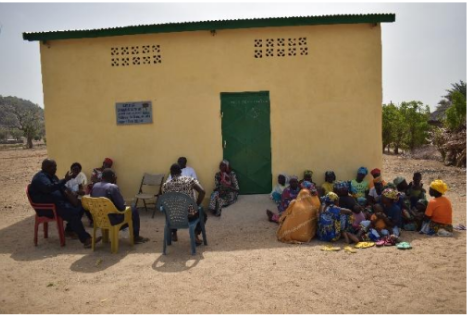
Dilapidated Granaries Rebuilt; New Rules Established
Cereal conservation is a crucial issue for rural communities which otherwise lack appropriate storage facilities for the grains they grow. As some of the first granaries constructed through RELUFA in 2006 and 2009 reach extreme states of deterioration, it’s becoming necessary to replace them and re-establish membership rules.
The original granaries were built using mud bricks. Defective roofing allowed water infiltration and made it easier for pests to enter, compromising the quality of the stored grains. Covering the bags of grains with tarpaulins to prevent deterioration was one method used to preserve the cereals during this period. Another was to temporarily store bags in private homes during the rainy season. Many people were uneasy giving up community control to individuals who might or might not follow rules closely and who charged a per-bag storage fee which members were not able to use for the advancement of the granaries.
New construction is now being carried out with active community participation. Members provide the sand, gravel, and water to create sturdier buildings. One village established a new 10-member board, and included three women serving as treasurer, advisor, and vice-delegate. The store’s operation is now based on clear rules, with two tiers of membership fees: one for board members and a quarter of that amount for others. Everyone pays a fee upon removing their bags of grains. In the event of inability to pay, an equivalent amount is deducted from the stored grain for sale. The internal regulations provide for the expulsion of members who refuse to pay these contributions.
The construction of the new warehouses represents a major step forward, enabling better storage of cereals in secure and sustainable conditions.
To ensure a sustainable supply of grain to the granaries, several communities have decided to create community fields starting this growing season. These fields will produce a large stock of grain to be stored in the new stores, thus reducing people’s vulnerability during the lean season.
Cameroon Far North Program
Led by Presbyterian Church (U.S.A.) and Local Partner Réseau de Lutte Contre La Faim (RELUFA)